PowerSplit - Log Bear Works

PowerSplit

8 Products

Powersplit International build commercial splitting systems in Canada for firewood yards that measure output in face cords per hour rather than in loads per weekend. Eight machines here, all 28 or 34 tons, all running a 5-second cycle, which is where their whole design argument sits.

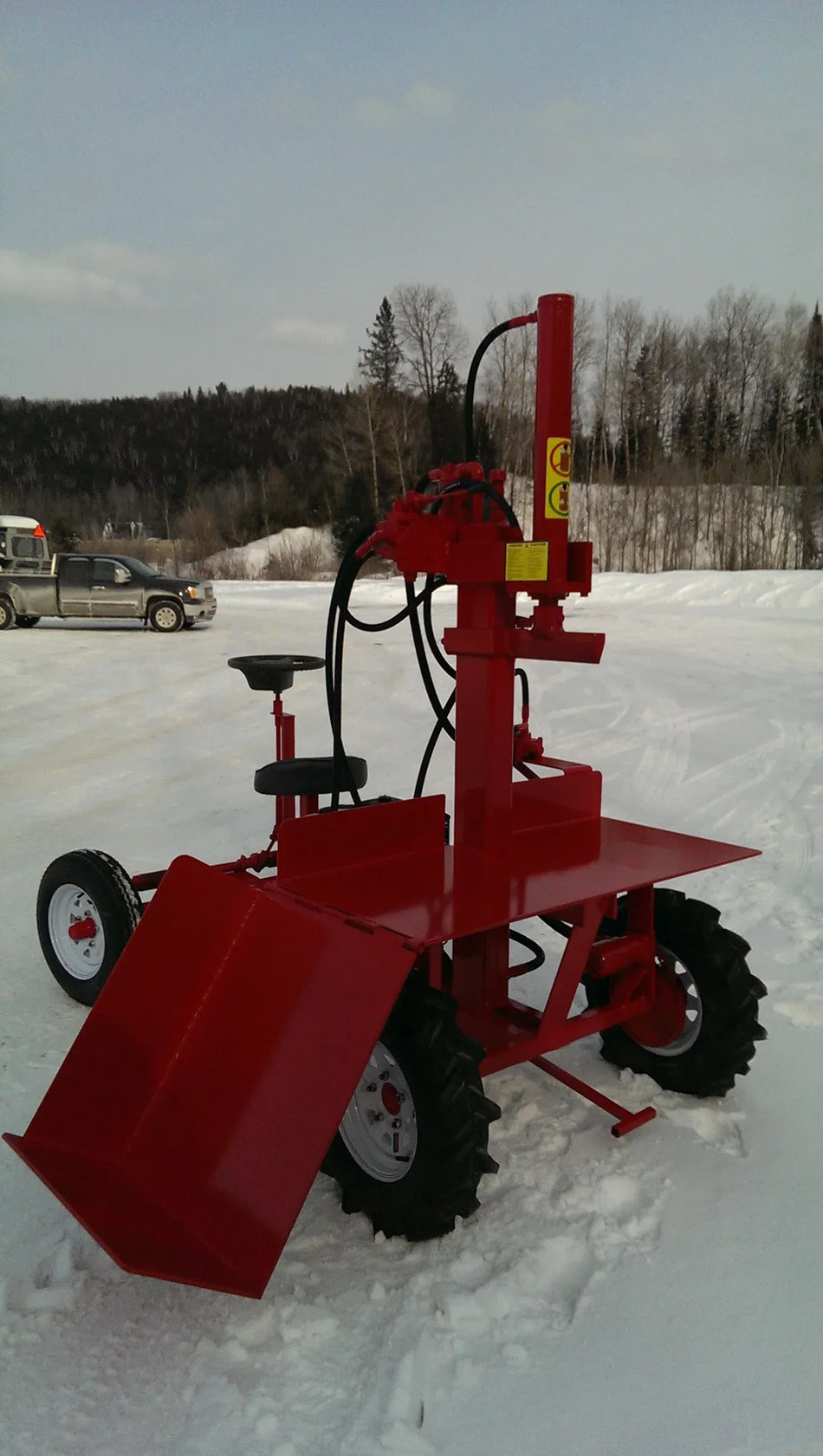
The vertical splitters with conveyor are the production machines. The single vertical handles up to 6 face cords per hour on one ram, and the double vertical runs two independent rams for up to 12. Both are self-propelled and pedal-activated, so the operator keeps both hands on the wood, and both take an optional 25-foot conveyor.

The Buggy range is the mobile side. The self-propelled Buggy moves itself around the woodlot at 700 pounds, and the Static Buggy is a tow-behind at 500 pounds for work that shifts between sites. Both come in 28 and 34-ton versions on Honda power from 9 to 13HP.

Worth being clear about what these are: Powersplit machines are splitters, not processors. They do not saw logs to length, so wood arrives already bucked. If you want a machine that cuts and splits in one cycle, see our Firewood Processors.

Why Powersplit International

  • 5-Second Cycle: Consistent across the whole range, which is what drives face cords per hour.
  • Up to 12 Face Cords Per Hour: The double vertical runs two independent rams.
  • Self-Propelled and Pedal-Activated: The machine moves and the operator keeps both hands on the wood.
  • Canadian-Made: Built for commercial firewood production.

How to Choose a Powersplit Machine

  • Output Target: One ram for up to 6 face cords an hour, two rams for up to 12.
  • Fixed or Mobile: Vertical systems suit a fixed yard. The Buggy range moves to the wood.
  • 28 or 34 Tons: 28 handles most production wood, 34 is the heavy duty build for knots and oversized rounds.
  • Conveyor: Optional 25-foot conveyor on the vertical models, which is what keeps the operator splitting rather than stacking.

Explore Related Firewood Equipment

More Ways to Run the Operation

Here are other collections for the rest of the yard:

Quick Product Comparison

Product Name Force Output Mobility Engine
Static Buggy Tow-Behind 28 ton 5-second cycle Tow-behind, 500 lb. 9HP Honda
The Buggy Self-Propelled 28 ton Up to 6 face cords/hr Self-propelled, 700 lb. 9HP Honda
Single Vertical with Conveyor 28 ton Up to 6 face cords/hr Self-propelled, 1,500 lb. 13HP Honda
Double Vertical with Conveyor 28 ton per ram Up to 12 face cords/hr Self-propelled, 2,500 lb. 20HP Honda
Double Vertical Heavy Duty 34 ton per ram Up to 12 face cords/hr Self-propelled, 3,000 lb. 24HP Honda

Broader Firewood Equipment Collections

Why Choose Powersplit International from Log Bear Works?

  • Canadian-made commercial splitting systems from 28 to 34 tons
  • Full manufacturer warranty included on every machine
  • Quoted individually, because conveyors, log lifts and motor upgrades change the build
  • Expert support from real people in the USA who can spec a system to your output target, by phone or live chat

Frequently Asked Questions

What does Powersplit International make?

Powersplit International builds commercial firewood splitters for production work rather than home heating. Every machine in the range is a 28 or 34-ton vertical splitter on a Honda engine, offered in four configurations: self-propelled buggy, tow-behind static buggy, single vertical with conveyor, and double vertical with conveyor. These are machines for people producing firewood in volume, often to sell.

Why are Powersplit prices shown as a quote?

Because these are configured commercial machines rather than off-the-shelf products. Conveyor length, engine specification and how the machine is set up for your yard all move the price, and a double vertical with a conveyor is a substantially different purchase depending on how you plan to run it. Tell us your production volume and layout and we will quote the actual build. Call +1 (307) 212-8335 or email sales@logbearworks.com.

What is the difference between the self-propelled Buggy and the Static Buggy?

The Buggy drives itself, the Static Buggy is towed. Both come in 28-ton on a 9HP Honda and 34-ton on a 13HP Honda. The self-propelled version moves under its own power, so it goes to the wood pile rather than the wood coming to it, which matters if you are splitting where logs fell. The Static Buggy sits where you put it and costs less, which suits a fixed yard where the wood arrives by loader anyway. If you are working across a property, take the self-propelled. If you split in one place, save the money.

What is a single vertical versus a double vertical splitter?

A double vertical runs two rams instead of one. In the 34-ton range the single vertical uses a 20HP Honda and the double vertical steps to 24HP, because the second ram needs the hydraulic capacity to feed it. The practical effect is that one operator can be loading one side while the other side is splitting, so the machine is never waiting on a person. That roughly doubles your throughput, which only pays if you have the log supply and the labour to keep both sides fed. For a single operator, the single vertical is the right machine.

Why do these splitters come with a conveyor?

Because on a production splitter, moving the split wood is what actually limits your day. The ram cycles far faster than one person can clear the output by hand, so without a conveyor the operator spends most of the shift bent over picking up pieces and the machine sits idle between cycles. A conveyor carries the split wood straight to a truck, trailer or stack, which keeps the operator at the splitter and the splitter running. If you are producing to sell, it is not an accessory.

How does a vertical splitter compare to a standard horizontal machine?

A vertical splitter stands the beam upright, so you roll the round into position rather than lifting it onto a horizontal beam. On big rounds that is the single biggest reduction in operator fatigue available, and fatigue is what ends a production day. The trade is that you work at ground level, which some people find harder on the back than standing at a beam. For occasional home splitting, a horizontal or combination machine is usually more comfortable; for all-day production on heavy rounds, vertical wins. Browse the wider range in our log splitters collection.